Diastasis Recti in Manchester and Cheshire

reza nassab icon

What is Diastasis Recti?

Diastasis recti is the separation of the two rectus abdominis muscles along the linea alba — the fibrous connective tissue that runs vertically down the midline of your abdomen. When intra-abdominal pressure exceeds what this tissue can withstand, the linea alba stretches and thins, causing the muscle columns to drift apart. A gap of more than 2.5 cm is considered clinically significant and is unlikely to resolve without treatment.

In Manchester & Cheshire, Mr Nassab sees diastasis recti most commonly in postpartum women, but it can also affect men, infants, and non-pregnant women — particularly those who have experienced rapid weight change or performed high-load abdominal training with poor technique.
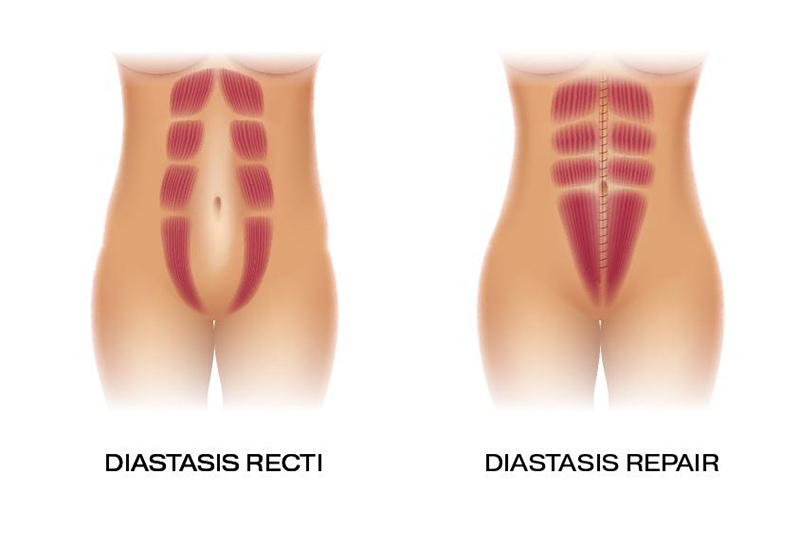
Understanding theAnatomy & Severity

The linea alba is formed where the anterior and posterior sheaths of the left and right rectus muscles fuse at the midline. It is widest at the navel — normally up to 22 mm above the umbilicus — and narrows below. During pregnancy, relaxin and progesterone soften the collagen fibres, making the linea alba vulnerable. Repeated high intra-abdominal pressure (coughing, heavy lifting, Valsalva manoeuvres) can stretch it further in anyone.

Grade 1 — Mild
< 3 cm

Often asymptomatic or minimal. May respond to targeted physiotherapy and core rehabilitation. Surgery rarely required.

Grade 2 — Moderate
3 – 5 cm

Core weakness, visible doming on sit-up, lower back pain. Conservative treatment has limited efficacy. Surgery usually recommended.

Grade 3 — Severe
> 5 cm

Significant functional impairment, prominent midline bulge at rest, risk of umbilical hernia. Surgical repair is the definitive treatment.

Mr Nassab's Clinical Note

Severity grading alone does not determine treatment. I assess the functional impact — core stability, lower back pain, urinary symptoms — alongside the gap measurement. A 3 cm separation causing significant daily impairment often warrants surgery, while a 4 cm gap in a highly active patient with good compensatory core strength may be managed conservatively for longer. Each case is individually planned.

How to Test Yourselffor Diastasis Recti

A simple at-home check can give you an early indication, though formal diagnosis requires examination by a surgeon or specialist physiotherapist. Here is a step-by-step protocol:

  • Lie on your back on a firm surface with your knees bent and feet flat on the floor.
  • Relax your abdominal muscles completely and breathe normally.
  • Place the fingertips of one hand horizontally across your midline, pointing toward your feet, at the level of your navel.
  • Slowly raise only your head and shoulders off the floor — as if beginning a crunch — while keeping your lower back on the ground.
  • Feel for a soft gap or depression between the two muscle columns. Count how many fingers fit within the gap.
  • Also assess whether your fingers sink deeply into the tissue (indicating low linea alba tension) versus finding firm resistance.
  • Repeat the check 2–3 cm above and below the navel, as the gap can vary along its length.
Interpreting Your Result

A gap of 1–2 finger-widths (approx. 1.5–2 cm) with firm tissue resistance is within the normal range. A gap of 2–3 fingers with soft tissue or your fingers sinking beyond the first knuckle suggests moderate separation. A gap of 3+ fingers, especially with visible doming, warrants surgical assessment. Book a consultation with Mr Nassab for an accurate measurement and treatment plan.

Symptoms & HealthConsequences

Diastasis recti is not purely cosmetic. The rectus abdominis, along with the obliques and transversus abdominis, form a functional cylinder of support for the spine, pelvis, and viscera. When the linea alba fails, the entire system is compromised. The following symptoms are commonly reported by patients attending Mr Nassab's clinic:

Symptom Why It Occurs How Common
Midline abdominal bulge or "doming" Unsupported viscera push forward through the gap on exertion Very common
Lower back pain Weakened core transfers load to lumbar extensors and erector spinae Very common
Pelvic floor dysfunction The pelvic floor and deep core work as a pressure system; failure at the front disrupts the whole Common
Stress urinary incontinence Ineffective intra-abdominal pressure regulation on coughing or sneezing Common
Hip and pelvic instability Altered load transfer from spine to pelvis and lower limb Moderate
Umbilical hernia The weakened midline can allow abdominal contents to protrude at the navel Moderate (severe cases)
Digestive issues / bloating Poor core containment affects GI organ positioning and transit Less common
Poor posture Anterior pelvic tilt as the body compensates for lost abdominal support Common
reza nassab icon

Who Gets
Diastasis Recti?

Postpartum women are most commonly affected — up to 60% of women have a measurable gap at 6 weeks postpartum, declining to around 30–40% at 6 months. Risk factors include multiple pregnancies, carrying large or multiple babies, and rapid successive pregnancies without rehabilitation in between.

Men are a frequently overlooked group. Obesity-related abdominal distension, heavy resistance training performed with incorrect Valsalva technique, and chronic constipation can all drive linea alba separation. The presentation and surgical approach are identical to the postpartum female case — there is no functional difference in technique.

Non-pregnant women can develop the condition through rapid weight fluctuation, certain abdominal training programmes (particularly those that over-prioritise rectus loading without transversus activation), and core deconditioning over time.

Infants can be born with or develop a physiological midline gap that almost always resolves spontaneously by two years of age and does not require treatment.

Causes & How toPrevent Diastasis Recti

Diastasis recti results from any situation where sustained intra-abdominal pressure exceeds the tensile capacity of the linea alba. Preventative strategies centre on managing this pressure load:

During pregnancy:

  • Prioritise transversus abdominis activation over rectus-dominant exercises such as crunches and sit-ups from the second trimester onward.
  • Use log-roll technique when getting out of bed — roll to your side first rather than performing a straight sit-up.
  • Wear a maternity support belt during high-load activities.
  • Maintain recommended weight gain as advised by your midwife or obstetrician.
  • Avoid prolonged breath-holding (Valsalva) during lifting.

In the general population:

  • Ensure correct core bracing technique during resistance training — brace outward, not suck-in.
  • Avoid excessive loaded spinal flexion (weighted sit-ups, GHD sit-ups) if you have a pre-existing gap.
  • Address obesity — chronically elevated intra-abdominal pressure is a major driver.
  • Treat chronic constipation, which causes repeated Valsalva strain.
Important: Exercises to Avoid

If you already have diastasis recti, the following exercises can make the gap larger and should be avoided until properly assessed: sit-ups and crunches, double-leg raises, front-loaded planks held for extended periods, heavy overhead pressing, and any movement that causes visible doming of the abdomen.

Non-SurgicalTreatment Options

For mild diastasis or as preparation before surgery, several non-surgical approaches can improve function and reduce symptoms. Understanding the realistic limits of each option helps set appropriate expectations.

Treatment Mechanism Best For Realistic Outcome
Specialist Physiotherapy Transversus abdominis & pelvic floor activation, postural re-education Grade 1 (mild, <3 cm); post-surgery rehabilitation Can improve function and reduce symptoms in mild cases; does not structurally close a >3 cm gap
Abdominal Binding / Support Belt External mechanical compression to support midline Symptom relief during recovery; post-surgical support Provides comfort; does not treat the underlying separation
Emsculpt / HIFEM Therapy High-intensity focused electromagnetic stimulation to contract muscles Mild cases; post-surgical muscle conditioning Can reduce inter-recti distance by ~10% in mild cases (Kinney et al.); not effective for moderate-severe
Targeted Exercise Programmes Gradual loading of deep core to restore tension in the linea alba Grade 1 under physiotherapy supervision Functional improvement; structural improvement limited in larger gaps
Pilates / Yoga (specialist-guided) Low-load deep core activation, breathing coordination Maintenance and prevention Excellent for function; no evidence for gap closure in moderate-severe cases
reza nassab icon

Does Emsculpt Work
for Diastasis Recti?

Emsculpt uses high-intensity focused electromagnetic (HIFEM) energy to induce supramaximal muscle contractions — the equivalent of approximately 20,000 sit-ups in a 30-minute session. Research by Kinney et al. demonstrated a mean reduction in inter-recti distance of around 10% in patients treated with Emsculpt.

In clinical practice, this translates to meaningful benefit only in Grade 1 (mild) cases. For moderate or severe separation, Emsculpt is not a substitute for surgery — the linea alba is structurally lengthened and cannot regain its original tensile properties through muscle stimulation alone. However, it can be a useful adjunct for post-surgical conditioning or for patients who are not yet ready for, or suitable for, surgery.

Surgical Repair ofDiastasis Recti

Surgery is the only treatment that structurally restores the linea alba. The procedure, known as muscle plication, involves suturing the separated muscle fascia back together, recreating the midline support of the abdominal wall. This is typically performed as part of an abdominoplasty (tummy tuck), though an isolated plication can be performed when excess skin is not a concern.

Surgical Procedure Walkthrough

  1. Consultation & planning: Mr Nassab performs a detailed examination to measure the gap at multiple points, assess skin laxity, evaluate the pelvic floor, and determine whether isolated plication or full abdominoplasty is the right approach.
  2. Marking: On the morning of surgery, the midline, extent of skin removal, and planned incision are marked with the patient standing to account for natural tissue distribution.
  3. Anaesthesia: Procedure is performed under general anaesthesia. A low transverse (bikini-line) incision is made, extended according to the degree of skin removal required.
  4. Skin flap elevation: The skin and subcutaneous tissue are raised from the underlying fascia up to the level of the xiphoid, exposing the full extent of the muscle separation.
  5. Muscle plication: The fascia of the rectus abdominis muscles is plicated (folded and sutured together) along the entire length of the separation — from the xiphisternum to the pubis — using permanent or long-lasting absorbable sutures. This restores the normal midline alignment and recreates linea alba tension.
  6. Umbilical repositioning: Where a full abdominoplasty is performed, the umbilicus is detached, the skin flap is advanced downward, and the navel is repositioned through a new opening at the correct anatomical level.
  7. Skin removal & closure: Excess skin and fat are excised. The incision is closed in layered sutures with fine intradermal sutures at the skin surface. Drains may be placed for 24–48 hours.

Isolated Repair vs. Abdominoplasty: Which Is Right for You?

Feature Isolated Diastasis Repair (Plication Only) Abdominoplasty + Plication
Addresses muscle gap Yes Yes
Removes excess skin No Yes — primary advantage
Removes excess fat No (liposuction can be combined) Yes
Repositions umbilicus Not typically Yes — corrects navel position
Scar length Shorter (depends on approach) Low bikini-line hip-to-hip scar
Ideal candidate Good skin elasticity, healthy BMI, functional concern only Post-pregnancy skin laxity, overhanging skin, combined aesthetic & functional goal
Recovery Shorter — approx. 3–4 weeks to office work Longer — approx. 4–6 weeks full recovery

Benefits ofDiastasis Repair Surgery

The benefits of diastasis recti repair surgery extend well beyond the cosmetic. Patients routinely report:

  • Restored core strength and stability — often the most life-changing benefit for active patients
  • Significant reduction in lower back pain, as the lumbar spine regains proper support from the anterior core
  • Improved urinary continence through normalised intra-abdominal pressure mechanics
  • Flatter abdominal profile — elimination of the "pooch" that persists despite diet and exercise
  • Improved posture and reduced anterior pelvic tilt
  • Relief from abdominal bloating and digestive symptoms in those where organ positioning is affected
  • Psychological benefit — restoration of body confidence particularly following pregnancy

Recovery AfterDiastasis Repair

Recovery from diastasis recti surgery is well-tolerated by the vast majority of patients. The timeline below reflects typical milestones when the repair is performed as part of a full abdominoplasty. Isolated plication recovery is generally shorter by 1–2 weeks at each milestone.

Timeframe Expected Progress Key Restrictions
Day 1–3 Discharge from hospital; swelling and bruising are normal; walking with slight forward lean; compression garment fitted No lifting >2 kg; no driving; rest with hips slightly flexed
Week 1–2 Drains removed; dressings changed; soreness reducing; short gentle walks encouraged No strenuous activity; no carrying children; light household tasks only
Week 3–4 Return to desk-based work for most patients; posture normalising; swelling decreasing Continue compression garment; no gym; no lifting above head
Week 5–6 Driving resumes (when able to perform emergency stop safely); wound fully closed; light social activity No impact exercise; no swimming until wounds fully healed
Week 8–10 Return to light gym work (lower body, walking, cycling); core sensation returning No direct abdominal loading exercises yet
Week 10–12 Graduated return to core exercise under physiotherapy guidance; final result becoming visible Avoid high-impact running and heavy compound lifts until cleared
6 Months Full internal healing complete; final scar maturation; core strength near full restoration No permanent restrictions; scar management continues

Risks & Complicationsto Be Aware Of

Diastasis recti repair is a well-established, safe procedure in the hands of a trained Consultant Plastic Surgeon. As with all surgery, risks exist and must be understood:

Risk Frequency Notes
Seroma (fluid collection) Common (10–15%) Most resolve with aspiration in clinic; drains reduce incidence
Haematoma (blood collection) Less common (1–3%) Small haematomas reabsorb; larger may require evacuation
Wound infection Less common (~2%) Antibiotic prophylaxis given; most resolve with oral antibiotics
Wound dehiscence Uncommon More likely in smokers; most heal with dressings
Scar widening or thickening Patient-dependent Silicone scar therapy from 6 weeks reduces risk
Numbness in lower abdomen Common initially Sensory nerves stretched during flap elevation; usually resolves within 12 months
Asymmetry or contour irregularity Uncommon Minor asymmetry may be apparent as swelling resolves; revision rarely needed
Recurrence of gap Low with permanent sutures Risk significantly increased if patient becomes pregnant after repair
DVT / pulmonary embolism Rare (<1%) TED stockings, compression devices, and LMWH used to minimise risk

How Much DoesDiastasis Recti Repair Cost?

At Reza Nassab Plastic Surgery, diastasis recti repair combined with abdominoplasty starts from £12,500 in Manchester & Cheshire. The final cost is determined at consultation and reflects the extent of muscle separation, the degree of skin removal required, theatre and anaesthetic fees, and post-operative care. An itemised breakdown is always provided in writing before any commitment is made.

Isolated plication without skin excision is priced separately. Finance options are available. Surgical repair is rarely funded by the NHS unless there is documented significant functional impairment — your GP can advise on local criteria.

Is Diastasis Repair the Same as a Tummy Tuck?

A tummy tuck (abdominoplasty) includes diastasis repair as a core component, but the two are not the same procedure. The plication of the rectus muscles is one step within the abdominoplasty — the tummy tuck additionally removes surplus skin and fat from the lower abdomen, and repositions the umbilicus. Conversely, an isolated plication closes the muscle gap without altering the overlying skin envelope. Mr Nassab determines which approach is appropriate based on your anatomy, your functional symptoms, and your aesthetic goals. For most postpartum patients presenting with both muscle separation and skin laxity, the full abdominoplasty provides the most comprehensive and lasting outcome.

Are You a Good Candidatefor Diastasis Repair?

Most adults with a clinically confirmed diastasis recti can undergo surgical repair. The following factors indicate particularly favourable candidacy:

Ideal Candidate Checklist
  • Confirmed diastasis recti (gap ≥ 2.5 cm) on clinical examination or ultrasound
  • Completed family — no further pregnancies planned
  • BMI within a healthy range, or close to your goal weight (within ~5 kg)
  • Non-smoker, or willing to stop smoking at least 6 weeks before surgery
  • Realistic expectations about scarring, recovery, and results
  • Good general health with no uncontrolled medical conditions
  • Functional symptoms (back pain, core weakness, incontinence) that have not improved with physiotherapy

Diastasis Recti Repair inManchester & Cheshire

Diastasis recti repair is performed by Mr Reza Nassab, Consultant Plastic Surgeon, at the boutique Deansgate Hospital in Manchester — a state-of-the-art private surgical facility. Consultations and pre-operative assessments take place at CLNQ clinic in Deansgate Square, Manchester, and at the Knutsford, Cheshire location.

Mr Nassab is a BAAPS member, GMC-registered Consultant Plastic Surgeon with extensive experience in abdominoplasty and muscle plication. He offers a fully bespoke surgical plan for each patient, with continuity of care from initial consultation through to final review.

Frequently AskedQuestions

What is diastasis recti and how do I know if I have it?

Diastasis recti is the separation of the two rectus abdominis muscles along the midline connective tissue (linea alba). A gap of more than 2.5 cm is clinically significant. You may notice a visible ridge or "doming" down the midline of your abdomen when you raise your head from lying, core weakness, lower back pain, or a persistent protruding belly that doesn't respond to diet and exercise.

Formal diagnosis is made by a surgeon or physiotherapist measuring the inter-recti distance. At-home testing (see above) can indicate whether assessment is warranted, but should not replace a clinical examination.

Can physiotherapy close a diastasis recti gap?

Targeted physiotherapy — particularly exercises focusing on the transversus abdominis and pelvic floor — can meaningfully improve functional symptoms and may reduce gap width in mild (Grade 1) cases where the linea alba retains some residual tension. However, once the linea alba has permanently stretched beyond ~3 cm, no amount of exercise can restore its structural integrity. The muscle columns may become functionally stronger, but the gap itself remains. Surgery is the only way to anatomically repair the separation in moderate and severe cases.

How long after pregnancy should I wait before having diastasis repair?

Mr Nassab recommends waiting a minimum of 12 months after delivery before surgery. This allows: natural postpartum recovery and tissue healing; a full trial of physiotherapy rehabilitation; breastfeeding to conclude (hormonal changes affect tissue quality); and confirmation that your weight is stable and near your goal. Operating too soon after pregnancy increases seroma risk, compromises healing, and means operating on tissues that haven't yet fully recovered.

Will I have a scar after diastasis recti surgery?

If performed as part of a full abdominoplasty, the scar runs low across the lower abdomen — typically sitting within or below the bikini line, so it is hidden by underwear and swimwear. The scar will be firm and pink for 6–12 months before gradually fading. Mr Nassab uses fine intradermal suture technique and advises silicone scar therapy from 6 weeks to optimise the appearance. Isolated plication may be performed through a shorter incision depending on the anatomical approach.

Can men have diastasis recti repaired?

Yes. Diastasis recti in men is more common than widely recognised, typically arising from obesity, heavy resistance training with improper technique, or chronic straining. The surgical approach — muscle plication with or without skin excision — is identical to the female procedure. The incision placement and extent of skin removal are tailored to male anatomy. Results are equally effective.

What is the difference between diastasis recti and an umbilical hernia?

Diastasis recti is a diffuse widening of the linea alba along its entire length, caused by stretching of the connective tissue. An umbilical hernia is a discrete defect (hole) at the navel through which abdominal contents can protrude — creating a lump that may become irreducible and require urgent treatment. The two conditions often co-exist. If you have both, Mr Nassab can address the hernia and the diastasis in the same surgical procedure.

How much does diastasis recti repair cost at Reza Nassab Plastic Surgery?

Diastasis recti repair combined with abdominoplasty starts from £12,500. This figure encompasses surgeon's fee, anaesthetist's fee, hospital fee, all post-operative appointments, and compression garment. An isolated plication procedure is priced separately. Finance plans are available. A full written quotation is provided following your consultation.

Can I have diastasis repair if I am planning more children?

Mr Nassab strongly recommends completing your family before undergoing repair. A subsequent pregnancy stretches the reconstructed linea alba, which can fully reverse the surgical outcome. For patients who are not yet certain about future pregnancies, physiotherapy and conservative management are the most appropriate approach until family planning is complete. The surgical results are far more durable — and cost-effective — when performed at the right time.

reza nassab icon

References

High intensity focused electromagnetic therapy evaluated by magnetic resonance imaging: Safety and efficacy study of a dual tissue effect based non-invasive abdominal body shaping. Kinney et al. Article

Mota P, Pascoal AG, Sancho F, Bø K. Test-retest and intrarater reliability of 2-dimensional ultrasound measurements of distance between rectus abdominis in women. J Orthop Sports Phys Ther. 2012;42(11):940–946.

Lee D, Hodges PW. Behaviour of the Linea Alba During a Curl-up Task in Diastasis Rectus Abdominis: An Observational Study. J Orthop Sports Phys Ther. 2016;46(7):580–589.

Diastasis recti repair before and after Manchester